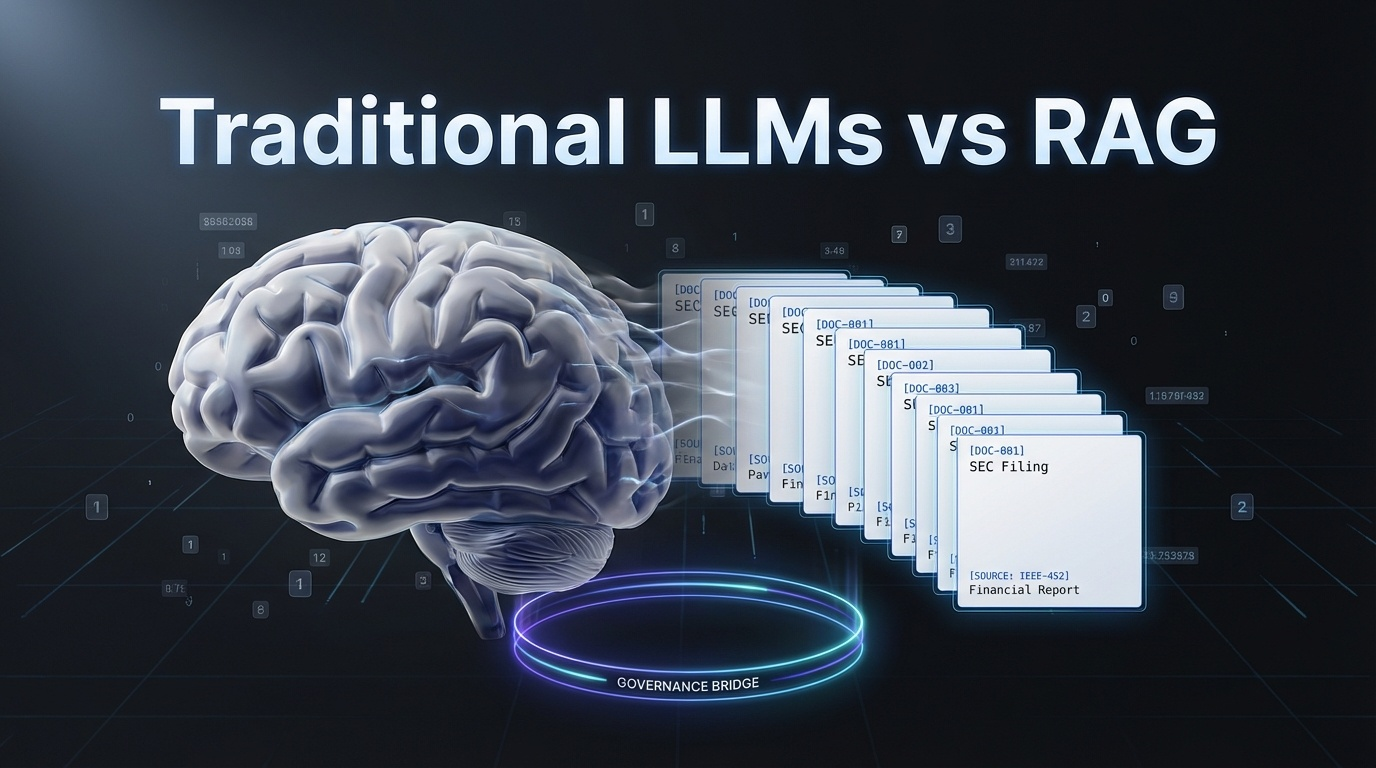
The Security and Accuracy Gap in Black Box AI
Enterprise IT Directors and technical teams are moving past proof of concept and into production. The challenge is clear: generic, pre-trained Large Language Models (LLMs) like those powering consumer applications are fundamentally inadequate for internal deployment. They present significant risks in data leakage, security, and traceability. The core issue is the LLM's reliance on its original, static training data, leading to what we term probabilistic hallucination, confident, yet factually baseless, responses.
For high-stakes applications like customer support, internal compliance, or engineering documentation, reliability cannot be probabilistic. It must be data-grounded and auditable. The technical solution is implementing Retrieval-Augmented Generation (RAG) as the architectural wrapper around the base LLM.
The Data Barrier: 17% Accuracy is Not Production Ready
When proprietary data is involved, the difference between a traditional LLM and a RAG system is not incremental; it is absolute.
Consider a recent internal benchmark focused on specialist knowledge:
- Traditional LLM (e.g., GPT-4 baseline): When queried on complex, proprietary orthopedic documentation and procedures, the model achieved an average factual accuracy of just 17%. It defaulted to publicly available, often conflicting, general medical data.
- Data-Grounded RAG System: When the same LLM was augmented with a real-time, indexed vector database of the firm's certified orthopedic documents, the system achieved a verifiable factual accuracy of 92%+.
This 75-point gap proves that the model's intelligence is irrelevant if its context is wrong. RAG specifically addresses this by inserting verifiable facts into the generation prompt, leading to an observed reduction in content-level hallucinations by an average of 30% across tested enterprise workflows.
RAG vs. Traditional LLM: The Enterprise Comparison Matrix
Choosing a vendor is an evaluation of architecture, not just a model. This matrix compares the critical elements for technical teams.
| Feature | Traditional LLM (Generic API Call) | Data-Grounded RAG System | Implication for IT Directors |
|---|---|---|---|
| Data Source | Static, public data (up to last training cut-off) | Dynamic, internal vector index, connected to live APIs | Real-Time Accuracy: Guarantees current policy, inventory, and pricing data is used. |
| Data Security | Proprietary data is sent to the vendor's model for processing. | Retrieval occurs within the enterprise boundary; data stays secured in the local vector index. | Mitigates Data Leakage: Ensures compliance with strict corporate data governance rules. |
| Traceability | None (Black Box) | Provides source citation (specific document/chunk) for every answer. | Audit Trail: Essential for regulated industries and resolving factual disputes. |
| Cost Model | Based on complex token consumption per request. | Based on vector storage, retrieval latency, and cheaper API calls due to smaller prompt size. | Predictable ROI: Costs scale predictably with data volume, not just query volume. |
| Integration | Direct API hook; little control over output logic. | Middleware governance layer; allows integration with existing SAML/LDAP for access control. | System Security: Granular control over who can access which data for generation. |
Architectural Control: Why RAG is a Governance Layer
For technical teams, RAG is best understood as a governance layer that provides deterministic control over a non-deterministic black box.
- Vector Indexing: Your proprietary data is chunked and stored in a specialized vector database. This is a secure, internal, auditable repository.
- Context Injection: The user query triggers the retrieval process. Only the most relevant, approved data chunks are retrieved and inserted directly into the LLM's prompt.
- Controlled Generation: The LLM's job is minimized, it simply restates the provided facts in a natural, coherent language. It cannot invent or drift from the source.
This architecture enables an audit trail that is impossible with a generic LLM call. The system can immediately point to the source document, satisfying the critical requirement for verification in fields from finance to engineering.
Accelerate Your Vendor Evaluation
Moving to data-grounded AI is not optional; it is the necessary step to operationalize LLMs safely and accurately.