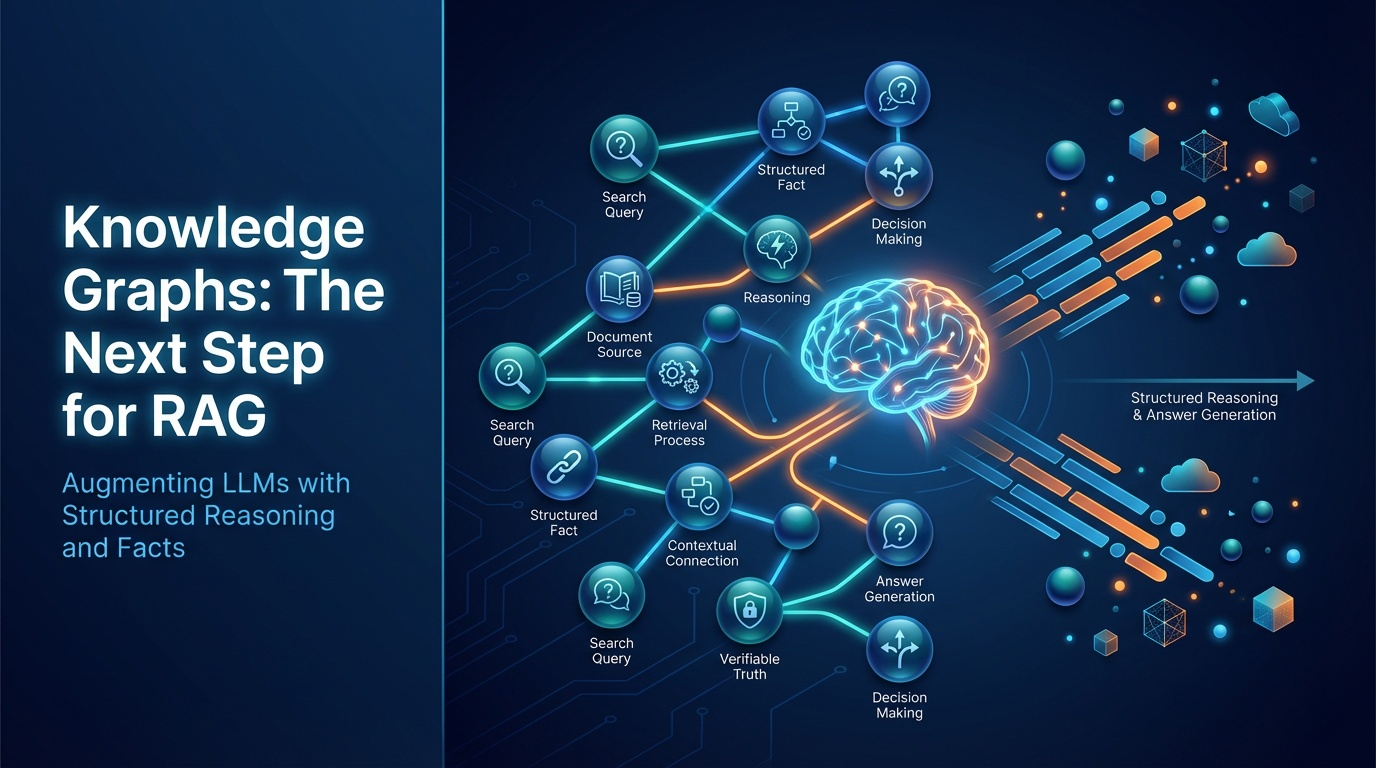
Beyond the Vector Store: The Limits of Semantic Search
For data scientists and ML engineers, the move from traditional LLMs to Retrieval-Augmented Generation (RAG) solved the immediate problems of hallucination and data freshness. The core RAG system—indexing document chunks into a vector store and performing semantic search—is now the standard.
However, complex enterprise use cases quickly expose the limitations of this vector-only approach:
- Context Window Overload: Searching hundreds of documents and feeding too many irrelevant chunks into the prompt can dilute the context.
- Multi-Hop Reasoning Failure: The system struggles with questions that require linking facts across separate documents (e.g., "What products are made by the subsidiary that acquired Company X in 2021?"). Vector search often returns disparate chunks without understanding the relationship between them.
- Low Precision on Ambiguity: Simple semantic similarity can confuse concepts that look similar but are logically distinct.
The next evolutionary step for RAG is integrating Knowledge Graphs (KGs) to address these precision and reasoning failures. This architecture positions your product as a truly sophisticated solution capable of advanced query resolution.
How Knowledge Graphs Elevate RAG Precision
A Knowledge Graph is a structured representation of knowledge that defines Entities
(things, people, concepts) and the Relationships between them. Instead of simple text
chunks, knowledge is stored as triples: (Source Entity → Relationship → Target Entity).
| Storage Mechanism | Data Representation | Strength |
|---|---|---|
| Vector Store | Embeddings of text chunks | Speed and scalability of simple semantic similarity. |
| Knowledge Graph | Triples (Entity-Relationship-Entity) | Contextual precision and understanding of deep logical connections. |
The Hybrid Architecture: RAG + Knowledge Graphs
The most powerful enterprise RAG systems now combine both approaches:
- Query Analysis: The user's question is parsed to identify key entities and relationships.
- Graph Traversal: The Knowledge Graph is queried to find connected entities and their relationships, providing structured context.
- Vector Retrieval: Simultaneously, the vector store retrieves semantically similar document chunks.
- Context Fusion: Both the structured graph data and unstructured text chunks are combined and fed to the LLM.
- Reasoning Generation: The LLM generates an answer that leverages both the logical connections from the graph and the detailed information from the documents.
Real-World Impact: Multi-Hop Query Resolution
Consider the query: "What products are manufactured by the subsidiary that acquired Company X in 2021?"
Vector-Only RAG: Returns disconnected chunks mentioning "Company X," "2021," "acquisition," and various product lists. The LLM must infer connections, often incorrectly.
Graph-Enhanced RAG: The Knowledge Graph directly traverses:
Company X → acquired_by → Parent Corp (2021)Parent Corp → owns → Subsidiary YSubsidiary Y → manufactures → [Product A, Product B, Product C]
The system returns a precise, traceable answer with full provenance—critical for regulated industries and high-stakes decision-making.
Implementation Considerations for Technical Teams
Building a graph-enhanced RAG system requires additional infrastructure:
- Graph Database: Technologies like Neo4j, Amazon Neptune, or Azure Cosmos DB for storing and querying the knowledge graph.
- Entity Extraction: NLP pipelines to identify entities and relationships from your documents automatically.
- Graph Construction: Tools to build and maintain the graph as your data evolves.
- Query Orchestration: Logic to determine when to use graph traversal vs. vector search, or when to combine both.
The Future of Enterprise RAG
As enterprises demand more sophisticated AI systems, the combination of vector search and knowledge graphs represents the cutting edge of RAG architecture. This hybrid approach delivers the speed of semantic search with the precision of structured reasoning.